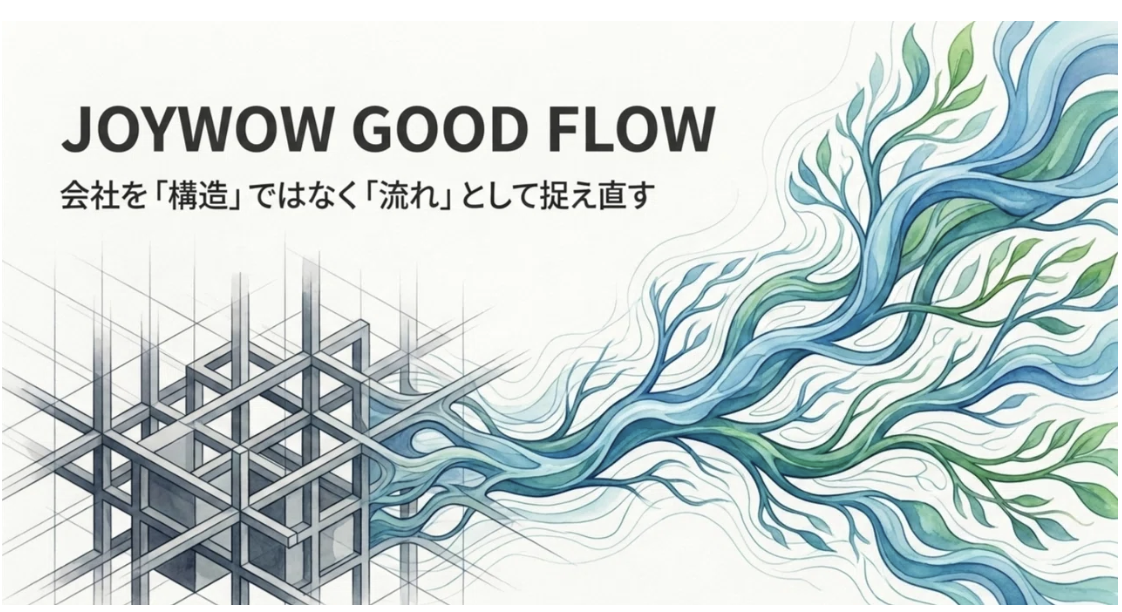
The “Constructal Law” proposed by Adrian Bejan, with his book “Design in Nature” being the most representative work.

I have long been thinking about applying the concept of this “Constructal Law” to business.
Whether it is customer acquisition, business flow, or internal information, a “good flow” determines results and enhances them.
This morning, finally, all the pieces clicked into place.
And this “flow” will become the pillar of JOYWOW’s consulting moving forward.
JOYWOW will no longer be a marketing consulting firm, but a Good Flow consulting firm.
Named;
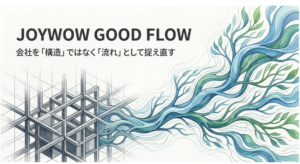
JOYWOW GOOD FLOW
Instead of trying to create results directly, we design a “good flow” where results are naturally born.
For example, suppose a sales department has a goal of 50 new contracts this term.
Instead of asking, “What do we do to get 50 contracts?”
we think,
“Where should we create a flow so that contracts are naturally born?”
Or, “Where is the rock that is acting as a brake on the flow?”
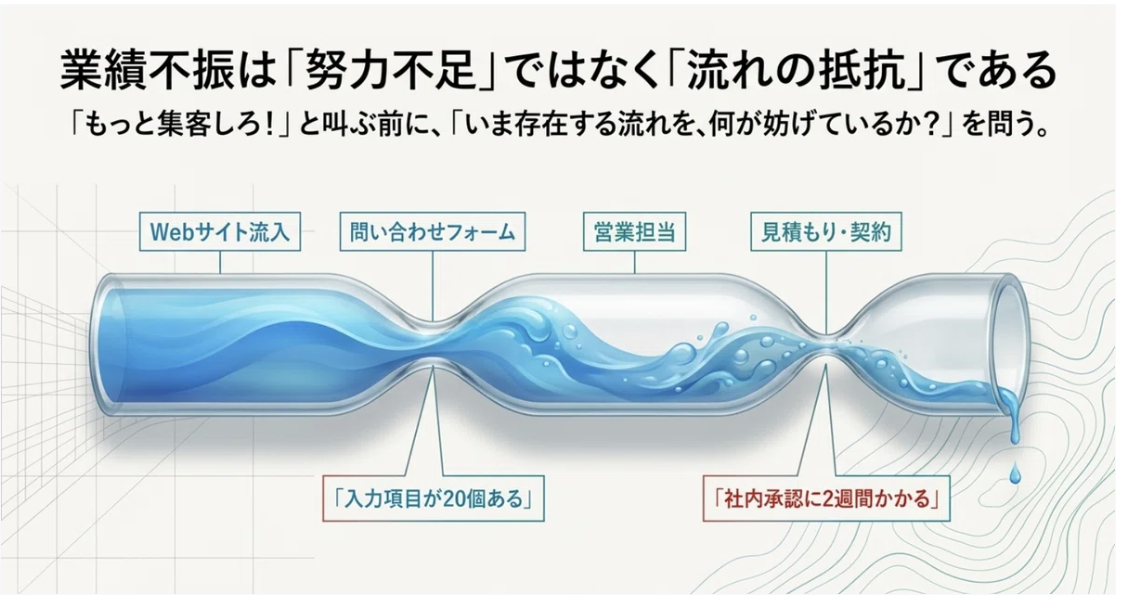
I have used this in actual consulting, and as a result, it led to a major shift in marketing strategy. We changed from B2C to B2B. It is a dramatic change, like Copernicus abandoning the geocentric model for the heliocentric model.
When observing current contracts as a “flow,” there are always rocks that block and clog the flow.
We re-examine those. People tend to focus on elements like product strength, price, “compatibility” with the business partner, sales ability, or advertising methods, but we do not view it that way. We observe it as a “path of flow.”
In other words, Results are the outcome of Flow.
I (JOYWOW) have stopped viewing the world as a “collection of things” and am viewing it as a “flow.” This becomes a philosophy, though (laughs).
For example, what happens when you view “management” as a “flow”?
There are five flows.
Flow 1: Flow of Customers: Don’t know -> Know -> Buy for the first time -> Buy repeatedly -> Become a loyal fan and recommend to others around them.
Flow 2: Flow of Information: Customer -> Frontline -> Person in charge -> Manager -> Management team.
Flow 3: Flow of Products: Raw materials -> Manufacturing -> Logistics -> Store -> Customer.
Flow 4: Flow of Money: Customer -> Sales -> Company’s financial system -> Investment/Return.
Flow 5: Flow of Ideas: Person in charge -> Team -> Experiment -> Commercialization.
Good management is the work of designing these five flows and making them flow better.
The merit of viewing things as a flow is that it prevents falling into the trap of partial optimization.For example, suppose sales are not growing.
So, you increase advertising expenses. Inquiries increase proportionally. The corresponding sales and technical departments cannot keep up with the manpower and crash.
What we must look at here is the question, “Are we meeting the customers we want to meet?” and not “increasing the number of customers we meet.” point.
What is the optimal number of customers and cases?
Optimal is defined by the “number of customers and cases that generate a good flow for us.” It is not about the size or quantity of the numbers.
It would be very long to write about the differences between traditional management and JOYWOW GOOD FLOW management, so focusing only on marketing:
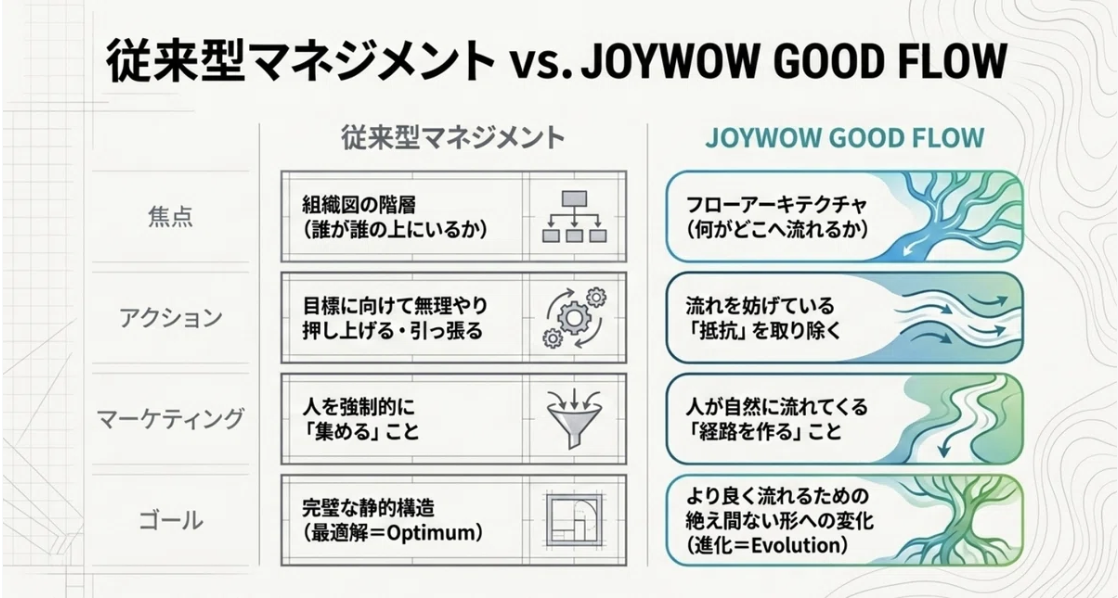
<Traditional Marketing>
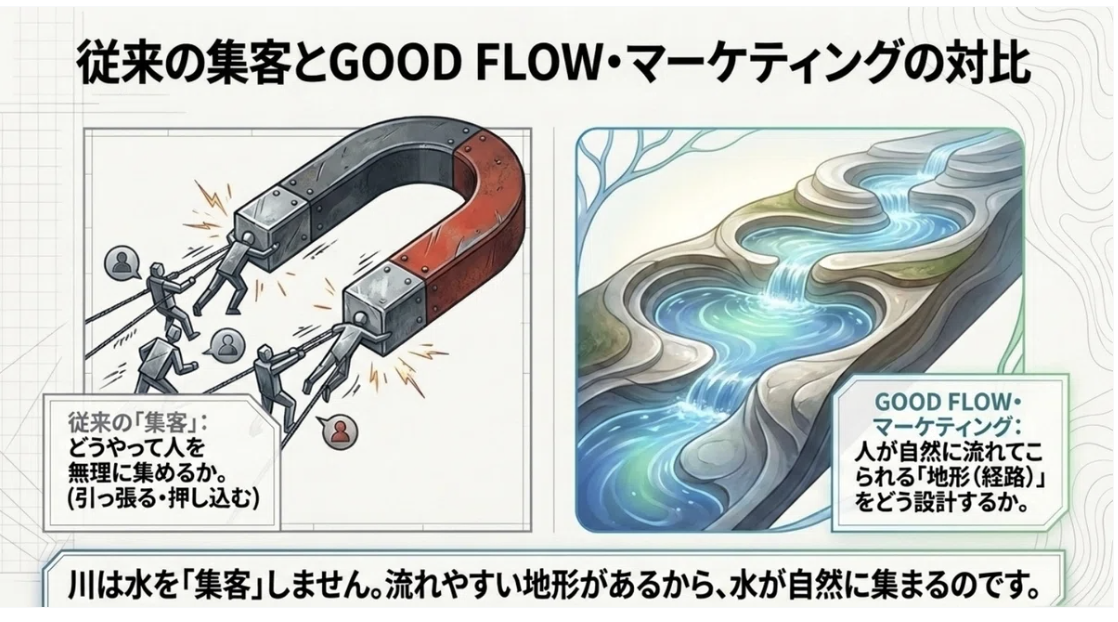
Prepare a large magnet and see how many people you can attract (customer acquisition).
Pulling/Pushing
<JOYWOW GOOD FLOW Marketing>
How to design the terrain (path) where people naturally flow (gather).
Come to think of it, rivers do not acquire customers. They do not market to water. Because there is terrain where water naturally flows in, water gathers naturally.
JOYWOW GOOD FLOW
Instead of trying to create results directly, design a “good flow” where results emerge naturally.
This autumn, I will be holding a one-day workshop.
I believe it will be helpful in increasing the JOY+WOW+LOVE and FUN in your business.







コメント